



The conversation around artificial intelligence in recruitment has reached fever pitch.
Every week there is a new tool, a new platform, a new promise.
AI can source candidates.
AI can write job descriptions.
AI can screen applications.
AI can automate outreach.
AI can generate interview questions.
AI can summarise CVs.
AI can analyse hiring data.
All useful.
But before organisations rush to automate recruitment, there is a more important question to ask:
Do we actually know what capability we are trying to build?
Because if the answer is unclear, automation does not solve the problem.
It simply makes the wrong process move faster.
The real issue is not recruitment technology. It is workforce design.
Across banking, technology, fintech, shared services and global business services, we are seeing a familiar pattern.
Organisations invest in recruitment technology, automation platforms and AI-enabled sourcing tools, but still struggle to hire the people they need.
The issue is rarely the tool itself.
The issue is what sits underneath it.
Unclear workforce planning.
Outdated job descriptions.
Misaligned stakeholders.
Slow decision-making.
Unrealistic expectations.
Poor understanding of local talent markets.
In other words, many hiring problems do not begin with recruitment.
They begin with strategy.
A business may say it cannot find talent.
But after closer inspection, the real questions are often more fundamental:
What capability does the organisation need over the next two to three years?
Which skills are becoming critical?
Which roles are likely to change because of AI?
Which work should be automated, and which work should remain human?
Which markets offer the right talent density, cost structure and scalability?
What leadership capability is needed to make growth sustainable?
These are not recruitment questions.
They are business design questions.
And they need to be answered before technology can add meaningful value.
When everyone has the same tools, tools stop being the advantage
There was a time when access to better technology created a clear competitive edge.
That advantage is narrowing quickly.
Most organisations now have access to applicant tracking systems, sourcing platforms, CRM tools, workforce analytics, assessment technology and increasingly powerful AI systems.
Soon, many will also have access to AI agents capable of performing large parts of recruitment workflows.
So if everyone can access similar tools, what becomes the differentiator?
Not the technology.
The judgement behind it.
One company uses AI to improve sourcing and makes better hiring decisions.
Another uses the same type of technology and simply generates more unsuitable candidates, more automated messages and more noise.
Same technology.
Completely different outcome.
The difference is not the tool.
It is the quality of thinking behind the tool.
AI amplifies good decisions and bad ones
AI is an accelerator.
That is both its strength and its risk.
If an organisation has clear workforce planning, strong hiring discipline and well-defined capability needs, AI can improve speed, reach and efficiency.
But if the foundations are weak, AI can just as easily amplify the wrong assumptions.
A vague job description becomes a vague AI-generated job description.
A poorly defined role becomes a faster-moving hiring mistake.
An unrealistic candidate brief becomes an automated search for someone who may not exist.
An unclear hiring process becomes a more efficient version of the same internal confusion.
This is why workforce design must come before automation.
AI works best when the organisation already understands what it is trying to achieve.
The organisations winning are not just filling roles. They are building capability.
The strongest companies are starting from a different question.
Not:
“How quickly can we fill this vacancy?”
But:
“What capability does the business need to compete, grow and adapt?”
That shift matters.
Because the market is changing faster than traditional hiring models were designed to handle.
Skills are changing.
Roles are changing.
Candidate expectations are changing.
Leadership expectations are changing.
Location strategies are changing.
AI is accelerating all of it.
A role that looks critical today may be redesigned in 18 months.
A skill that feels niche today may become essential tomorrow.
A market that once looked attractive on cost alone may no longer provide the capability required for regional growth.
That is why recruitment cannot be treated as a purely transactional function.
It needs to be connected to business strategy, workforce intelligence and market insight.
Workforce intelligence is becoming a boardroom issue
For organisations entering or scaling across Poland and Central and Eastern Europe, the key questions are becoming more strategic.
Where is the right talent located?
Which cities provide the strongest specialist capability?
How do salaries compare across Poland, Hungary, Romania, Czech Republic and other CEE markets?
Where are competitors building teams?
Which roles should be hired locally, regionally or remotely?
Which functions are better suited to a shared services, GBS or capability hub model?
How quickly can the organisation scale without creating unnecessary risk?
This is where workforce intelligence becomes valuable.
Not as a report that sits in a folder.
But as a practical decision-making tool.
Good market intelligence helps organisations understand where talent exists, what it costs, how accessible it is, what candidates expect and how competitors are positioning themselves.
That insight can influence whether a company enters a market, expands a team, builds a centre of excellence or redesigns its operating model.
Market entry is a talent decision as much as a location decision
Many organisations considering expansion into Poland or the wider CEE region begin with cost, infrastructure and legal structure.
Those factors matter.
But the success of a new market entry often depends on something more practical:
Can the organisation actually build the team it needs?
A market may look attractive on paper, but if the required talent is scarce, expensive, heavily competed for or concentrated in a different location, the growth plan becomes more difficult.
This is especially true in areas such as financial services, risk, technology, engineering, AI, data, transformation and shared services leadership.
Entering a new market without workforce intelligence increases risk.
Entering with a clear view of talent availability, salary expectations, competitor activity and hiring timelines gives leadership teams a stronger foundation for decision-making.
That is where recruitment becomes far more than role filling.
It becomes part of market entry strategy.
Capability building requires more than hiring
Hiring is important.
But hiring alone does not build capability.
Capability comes from the combination of people, structure, leadership, systems, culture and learning.
An organisation may hire strong individuals and still fail to build a strong function if the team design is wrong.
Equally, a company may not always need to hire externally. The better answer may be reskilling, internal mobility, contractor support, leadership development or redesigning work around AI and automation.
That is why the workforce conversation needs to be broader.
The right question is not always:
“Who should we hire?”
Sometimes it is:
“What should this team become?”
And from there:
What work should humans do?
What should technology do?
What should be outsourced?
What should be built internally?
What should be scaled regionally?
What should be redesigned completely?
These are the questions that shape long-term competitive advantage.
A smarter sequence for AI in hiring
The organisations seeing the strongest results from recruitment technology tend to follow a more disciplined sequence.
First, they define business objectives.
Then they map current capability.
Then they identify future workforce needs.
Then they assess market availability.
Then they decide what needs to be hired, developed, automated or redesigned.
Only after that do they decide where technology can help.
That sequence matters.
Because technology should support workforce strategy, not replace it.
AI can help organisations move faster.
But it cannot decide what kind of organisation they are trying to become.
The future belongs to organisations that combine technology with judgement
AI will play a major role in recruitment and workforce planning.
That is no longer in question.
The more important question is how intelligently it will be used.
The organisations that thrive will not be the ones that automate the most.
They will be the ones that combine technology with strong judgement, clear workforce design and honest market intelligence.
They will understand that hiring is not only about filling vacancies.
It is about building capability.
It is about entering markets with less risk.
It is about scaling teams with better information.
It is about designing work in a way that matches where the business is going, not where it has been.
Belvedere’s view
At Belvedere, we believe the future of recruitment sits at the intersection of talent, strategy and market intelligence.
Organisations do not just need more candidates.
They need better insight.
They need to understand where capability exists, how markets are moving, what skills are becoming scarce and how to build teams that can support growth over time.
That is why our work goes beyond filling roles.
We support organisations with:
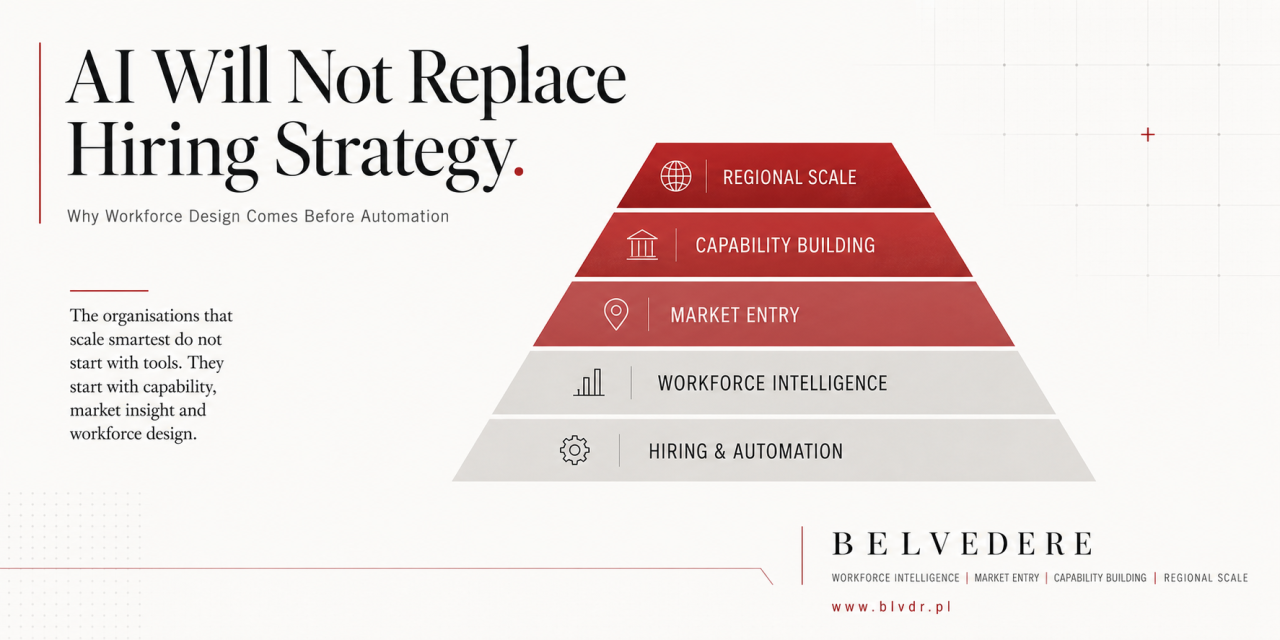
Workforce Intelligence — understanding talent markets, salary movement, competitor activity and skills availability.
Market Entry — helping companies assess where and how to build teams across Poland and CEE.
Capability Building — supporting the development of specialist functions, leadership pipelines and future-ready teams.
Regional Scale — helping organisations grow across Central and Eastern Europe with less risk and better talent insight.
AI will continue to change recruitment.
But it will not replace hiring strategy.
It will not replace market understanding.
It will not replace trusted relationships.
And it will not replace the need for organisations to make clear decisions about the capability they need to build.
The companies that understand this will not simply hire faster.
They will scale smarter.